return
to homepage
go
to personal photo album
go
to resumé or CV
Miles
Williams Mathis:
an
Extended Biography
(for the
curious as well as old friends)
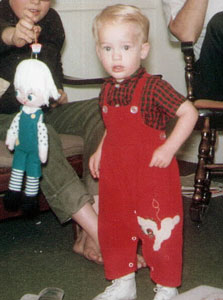
Although some believe he may have been hatched from an egg deposited in mysterious ways in the 19th century or cloned from the fingernail clippings of a Florentine Fra, trusted paperwork informs us that Miles Williams Mathis was born in Amarillo, Texas, on the 17th of September, in the wee hours of the morning. Scant months later, we imagine, he must have ventured from his swaddling clothes and stuffed animals, upon hands and knees, muling and burbling, in search of his first crayon.
In
hindsight, his earliest claim to an artistic future would appear
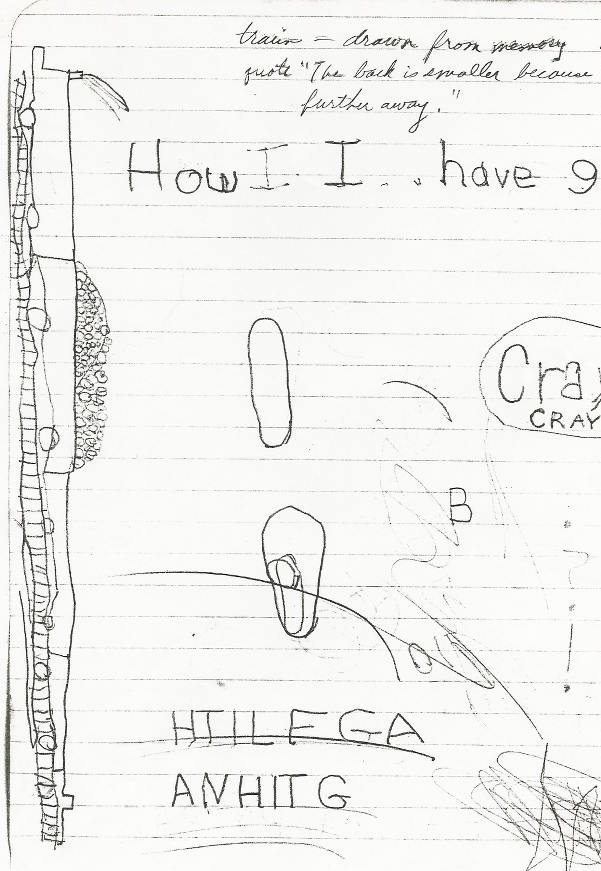
to be a train drawn with perspective when he was four years old.*
The drawing was saved and his mother dated it and wrote on it this
exchange: (Mom) "But Miles, why is the caboose smaller than
the engine?" (Miles) "Because it is farther away."
Miles' parents were not artists and he had not been taught
perspective, so this was not a leading question.
When Miles
was four the Mathis family moved to Lubbock, Texas. In grade
school he was remembered by classmates for his wall-size dinosaur
and evolution murals, his Peanuts
cartoon copies, his perfect
signature forgeries, his very animated singing in choir, his
pretty girlfriends, and his vast time in the hall and in the
principal's office. He distinguished himself even more for F's in
citizenship than for A's in everything else.
Having
skipped first grade and being a year younger than everyone else,
he entered puberty late compared to his classmates and was left
behind socially in junior high. The pretty girlfriends were no
more. This gave him time to get involved in just about everything
else. In junior high he became disenchanted with art classes and
never took another one. Instead he joined the band and the choir,
the tennis team and the golf team—in short, became a nerd. His
posters helped a best friend (who carried a briefcase) become
student body president, and the nerds temporarily ruled.
As
a young teenager Miles was one of the top junior golfers in the
state, winning many regional tournaments. [He shot a 76 at age 12,
on a course he had seen only once.] He also won several local
tennis tournaments. In this period he became a fledgling wildlife
artist, beginning by copying Clark Bronson drawings when he was
11, moving on to drawing from wildlife photographs in magazines
like National
Geographic and
finally working from his own photographs and from nature.
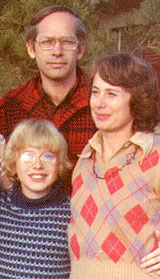
Miles attended
Monterey High School and excelled in many areas there. He won
several UIL science medals, was twice first chair all-region band
{tenor saxophone}, won awards with the jazz band, was a finalist
in writing contests, and was chosen to design various visual items
(such as prom invitations, tickets, and brochure covers) despite
not being in the art classes. In addition, he was the national
Latin
champion for two years. As a senior he won the JCL scholarship
from the state committee of classics. He was also a National Merit
Scholar and won the local National Honor Society Scholarship. He
should be remembered* by the takers of the PSAT, 1980, for
questioning one of the answers on the math portion. The PSAT
admitted its error and was forced to change all scores nationally.
Miles' score [as a senior]: 68/78:214.
He turned down
several scholarship offers in engineering, including to Rice and
the University of Texas, instead choosing to study liberal arts at
Haverford College. Unhappy
there [see end of paper in link], he followed a girlfriend to
the University of Texas, Austin, after only one semester. He
immediately tested out of a year and half of classwork, including
16 hours of Latin. He had 82 hours of credit before he started his
second year. Taking a bit of a breather, Miles loaded his schedule
with PE credits like diving, gymnastics and ballet. He was soon
tapped by his ballet teacher to join a local company, where he
danced for two years, including a minor role in Sleeping
Beauty. He
also began publishing a comic strip with the Daily
Texan, one of
the largest and best student papers in the country (and the
breeding ground for such cartoonists as Berke Breathed, Sam Hurt,
and Chris Ware—in 1980 Breathed had just taken his student strip
Academia Waltz
into syndication as Bloom
County).
Miles' strip Squib
was was published for three
years to wide acclaim and national awards before being picked up
for syndication by King Features as part of The
New Breed.
Meanwhile,
Miles reached the end of his second year only 9 hours short of a
degree. In the fall of 1982 he had applied for a Rhodes
Scholarship, but having just turned 19, he was told by the
committee to wait another year and try again. Unimpressed with the
committee—whose chairman was later fired for faking his
resume—Miles declined. Rather than take the 9 hours in summer
school and graduate at age 19, Miles decided to tour
Europe on his bicycle that summer with his younger brother.
Landing in Frankfurt, they rode south to Italy through the Black
Forest and over the Alps. In Rome they turned back to Paris and
eventually closed the circle to Frankfurt, with many a mishap
along the way—including the younger brother's Vespa crash in
Rome and Miles' impact with a car door in Sienna.
Miles'
senior year was a very light load of conference courses in Latin
and philosophy (and some sitting-in on graduate courses). He wrote
his paper for Special Honors in philosophy for Paul Woodruff on
Plato, and also won the Matchette paper contest with an entry on
post-existentialism. He graduated summa
cum laude with
keys from both Phi
Beta Kappa and
Phi Kappa Phi
honor societies.
A
summer of cartooning, dancing with the ballet, and being a disc
jockey at a local club was not enough to impress the parents, and
he bowed to their pressure to enroll at the LBJ School of Public
Affairs in the fall (a law school compromise, basically). The LBJ
School, along with Georgetown in DC, was one of the top two public
affairs schools in the country at the time. Miles was given a full
merit scholarship, and he landed an in-demand class with Barbara
Jordan his first semester. But, unimpressed with the curriculum
and feeling out of place, he returned his scholarship money and
set himself adrift. While continuing to cartoon, dance, and ride
his bike, he moved from one short-term job to another, including
waiting tables and being the Children's Summer Series coordinator
for the Austin Symphony Orchestra. Finally, finding the comics
page to be even more obsolescent than painting, he drifted to the
latter, slowly developing a new course of auto-didacticism.
In
1986 the great Spanish portrait painter Joaquin
Torrents Llado came to Austin to paint the Governor's wife.
Miles saw a show of his work and immediately made his
acquaintance. Soon he was invited to watch the master paint, and
it was here that the torch was passed. Miles had found a living
mentor, if only for a few hours.
In 1987 Miles began
copying from the old masters, at first from books and then making
trips to museums. His first museum copy was a
Sargent at the Dallas Museum of Art, where he was the first
copyist in history. Until Miles asked for permission, the DMA
didn't even have a policy. He was at first denied permission,
since the curator didn't know what to do in the event. The
director finally relented, and some four hours later Miles was
done, having learned what he came to learn. A similar encounter
did not turn out so favorably at the Kimball in Fort Worth, where
Miles wanted to copy a Van Dyck. He was refused, the museum's
policy being no copywork due to the size of the museum. The
Kimball claimed that the copyist would block foot traffic, but of
course this poses no problem in the more crowded museums of
Europe—where tourists seem to enjoy seeing copyists.

Miles next went
to the San Antonio Museum of Art, where the staff were much
friendlier and accommodating. There he copied a detail of
Bouguereau's Admiration.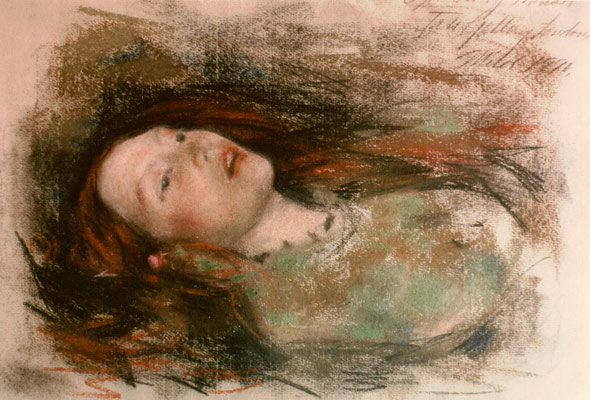
In
1990, Miles won the Basil Alkazzi Award to travel to London, where
he did copywork at the Tate Gallery (now Tate Britain) and the
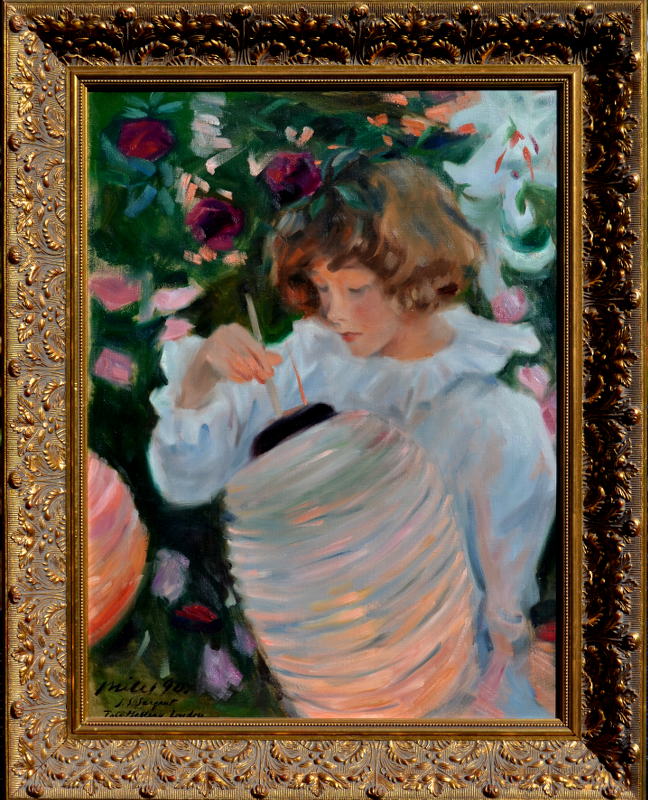
National Gallery. At the Tate he copied a
detail of Sargent's Carnation,
Lily, Lily, Rose in
oil and copied a detail of Millais' Ophelia
(above) in
pastels. The Sargent copy—like the one in Dallas—took about
four hours, and he turned down several buyers on the museum floor.
One tourist said he thought the copy was better than the original
(Miles disagreed strongly). Another laughed and said that Miles
must be Sargent's ghost, just remembering what he had already
done. The museum curator liked the copy so much he offered to hang
it on his office wall to dry while Miles went to Oxford to copy at
the Ashmolean. Miles gladly accepted, though he doubted that this
was standard procedure with copyists.
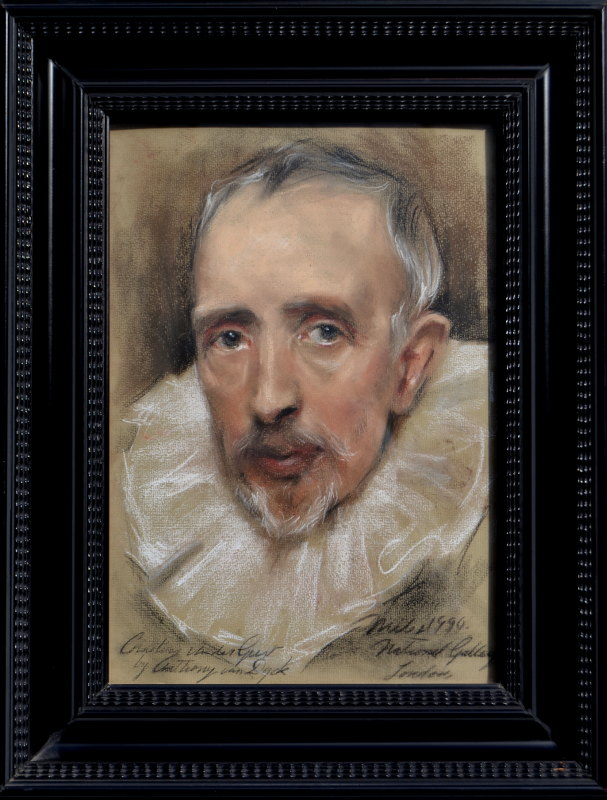
At the National
Gallery, Miles failed to get permission to copy in oils. One must
jump through a whole series of time-consuming hoops there,
including offering referees. So he decided to copy
Van Dyck's Cornelius
van der Geest in
pastels. This was also strictly against the rules, but Miles
worked so fast that by the time the guard noticed him he was
finished. The guard came over to complain and Miles said, "OK,
done! Bye!"
At the Ashmolean,
the Christofano Allori he had come to copy was hung too high to
see without glare. So Miles again played cat and mouse with the
guard, standing on a forbidden chair to take a forbidden
picture.
On this trip Miles also stopped in Windsor to see
the picturesque town and castle. Having his sketching materials
with him, he climbed a ten-foot iron fence on the back lawn to
sketch the queen's horses in their royal blankets. The guards did
not appreciate the novelty of this, and they chased him through
the streets of Windsor with their whistles blowing. He was caught
(with a copy of Thoreau's Civil
Disobedience in
his backpack) and severely reprimanded, but ultimately let off
with a warning.
Tired of the big-city rigamarole and the
police chases, Miles escaped to Dorset to finish off his
scholarship money. Going to Evershot, home of the Tess cottage,
Miles was let off the train at a "request only" stop in
the middle of a field, where he had to hike ten miles into town,
over hedgerows and through fields of bluebells. He felt lost in a
scene from The
Woodlanders,
until a nice lady in a tiny Mr. Bean car helped him with his easel
and canvases over the last stretch of highway, and saved him a
little legwork. In Evershot he stayed in a loft over the butcher's
and had dinner with the pretty gardener across the street. She
introduced him to the next door neighbor, who paid him 50 pounds
to draw a small pastel view of his thatched-roof house.
Other
art trips to Bruges, Vienna, Salzburg, Munich, Bordeaux,
Copenhagen, Paris, Goteburg, Rome, Florence, and Venice were
equally enlightening if somewhat less "disobedient."
Miles never seemed to learn a respect for authority however, as he
was ejected from the Cathedral in Vienna at Christmas mass in 1999
for wearing a stocking cap (after a nasty look from the Cardinal
himself).
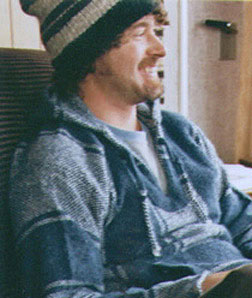
In his defense,
he tells me it was about 2 degrees celsius that day inside the
church, and many old men no doubt died of consumption that week
from attending the service (only the women were allowed common
sense, and fur caps). Miles has always been a strong defender of
feminism, including all that it requires in a full and logical
implementation.
From the beginning of his career Miles has
been the subject of both admiration and conflict. At an early show
in Lubbock, Miles removed his work from the walls with his own
hands after abnormalities in judging, even though he was a
multiple award winner. He has given a tongue lashing to judges at
the Akron Society of Artists, ASOPA and the National
Sculpture Competition, among others. In Austin he was the
go-to person for dissenting commentary on art in the newspaper: no
one else wanted to go on record contradicting the status quo. For
his opinion on the AIDS "Day Without Art" he was
banned from some local businesses, and once wore a scarlet letter
A when being asked to leave one of them. He also spoke out
strongly against local architecture and architects, and the
opposition in one of these skirmishes secretly changed its media
presentation in response to one of Miles' letters to the editor.
More recently he has become notorious for his attacks both upon
the avant garde and upon the new realists, including the directors
at the Art Renewal Center.
His
letters have amused and exasperated editors at many of the major
newspapers and magazines in the US (and more recently in the UK).
An especially strong letter to Antiques
and Fine Art had
the appearance of bringing the magazine down altogether, as it
folded soon afterwards. Time and again Miles' strongly worded
rebukes and exhortations have caused people at many different
levels and from many different backgrounds to reassess their
positions. No longer can the leading critics publish facile
opinion uncontested. There is a daemon lurking and they now know
it.
In 2003, Miles sent a
letter to the London newspapers, criticizing the decision of
the Tate Britain to allow Rodin's The
Kiss to be
wrapped in string by a contemporary artist. He recommended that
London realists storm the museum with scissors. The letter was
printed in full by the Independent,
and less than two weeks later a London artist was arrested for
cutting the strings off the sculpture. He was not charged.
For
the first time in decades, the left has serious opposition from
within its own ranks. The Art Renewal Center hired Miles to attack
the left, not realizing that he was the strangest of bedfellows.
Had they known that they had hired a former worker for Earth
First, a card-carrying member of Greenpeace, and a campaign worker
for Ralph Nader, they would surely have been kept up nights. Miles
learned to write by reading Thoreau and Wendell Berry, so it is
unlikely that he would share the political views of the neocons.
Miles' readings of Nietzsche—another mentor—had steered him
not to Ayn Rand and Social Darwinism, but to an artist-centered
theory of art that would turn out to be a truly extraordinary
stance at the end of the 20th century. This stance has allowed
Miles to critique both the left and the right from a position of
unassailable power: a stance of power since it is ultimately
futile to deny that the artist is the primary hand and voice of
art. Only another artist could logically have the standing to
refute him, and no true artist would do so. What artist would
argue that non-artists should control art?
In 2000 Miles
moved to Amherst, Massachusetts, where, snuggled in among the five
colleges, he began his serious scientific studies. He had majored
for a short time in physics and astronomy at UT Austin, where he
impressed his professors with a very quick mind. In his first
course in physics, one designed to weed out the weak, the class
average was 52. Miles ruined the curve with a 100. In astronomy it
was the same: Miles had the high average among all the large
first-year classes. This was reminiscent of high school, where the
calculus teacher had a longstanding trick of asking all his
second-year algebra students a pre-calculus question, a leading
variant of the problem Newton and Leibniz were working on when
they invented the calculus. No one had ever answered it correctly.
Miles did.
He had also kept up his readings in science
since college, although this consisted mainly of updates on the
latest theories. But, unsatisfied with the direction these
theories were taking, Miles finally began studying the history of
theoretical physics in earnest, especially as it related to
classical mechanics and basic physics. He bought a small library
of old books like Newton's Principia,
Euclid's and Archimedes'
treatises, Maxwell's papers, and all of Einstein's original
writings. He also brushed up on his calculus and began looking
into the origins of that math. This ultimately led him to Cauchy
and Cantor, set theory, topology, physical chemistry, cosmology,
and several other subfields, which he investigated to whatever
ends he was following at the time.
His galleries now full
of paintings (and selling quite slowly), he was free to write
papers of his own. In the ten [now twenty] years since, Miles has
written many books worth of papers, all of which investigate
mathematical anomalies within broader physical theories or higher
maths. These papers are published on a website linked
to his art website as well as at a larger online journal devoted
to dissenting opinion in physics (Walter
Babin's alternative journal, where Miles got ten million hits
in the first two years). Since the first of these papers concerned
Relativity, and since Relativity is considered by the status quo
to be a closed and finished field, Miles' papers have been
censored and slandered by the universities. Some university
professors are beginning to take note, however. The current
theoretical wall in physics has led even some top names out of
standard channels, and a few appear to be trolling the internet
for new possibilities. Miles has been contacted by several
professors worldwide, [recently added: and in 2010 he was
contacted by an astrophysicist at NASA and Johns Hopkins, who
recommended he publish in book form ASAP. This NASA scientist even
offered to write the introduction, and Miles' first
physics book came out in the summer of that year. Another
reader offered to bankroll his second book, which came out in late
2011. A third was published in 2013 and a fourth in 2017. In 2015
his paper on the
Gravity Wave announcement caused a major stir in academia,
ultimately killing the story and possibly preventing a Nobel
Prize. Other papers have sent similar ripples through mainstream
physics, and Miles has now been called by some the most
revolutionary voice in science. He lays claim to the title of
being the first professional artist who has had a book on
theoretical physics recommended and introduced by an
Oxford-graduate and NASA physicist.]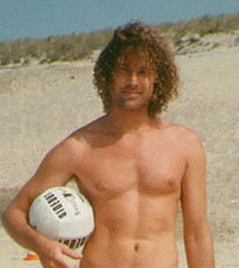
Montalivet,
France
In
2004 Miles moved to Bruges, Belgium, a preferred retreat. In this
true artists' town, where stand statues to Jan van Eyck and Hans
Memling (and the mathematician Simon Stevin), Miles could retain
equilibrium while fighting on a thousand fronts. Solace in the
form of silent swans and brooding canal bridges and rooftops
glistening from a recent rain were always but a few steps away,
out his green door. The finest chocolate and beer in the world
could remove him instantly from the messiest squabble, keeping his
faced unlined and his eyes bright and his brush hand (the left)
steady.
Also calming is his piano, which he plays almost
daily. After a year of lessons when he was 12, Miles waited 20
years to take up the instrument again. At that time he began
teaching himself what would be considered an impossible repertoire
for someone with one year of childhood training. Remembering only
Bach's Minuet,
he jumped immediately into Debussy's Claire
de Lune. With
that under his belt he added The
Girl with the Flaxen Hair and
Reverie,
then Ravel's Pavane
for a Dead Princess,
Liszt's Consolation
#3,
Schumann's Romance
#2 and Of
Foreign Lands and People,
Tchaikovsky's Seasons,
Rachmaninov's
Prelude in G,
Satie's Gymnopedies,
a couple of Chopin Etudes,
and many others. Some of these pieces are beastly difficult in
timing, but none are especially fast (except perhaps parts of
Claire de
Lune).
In
the winter of 2007, while on vacation in Spain, Miles solved what
has been billed as the oldest surviving math problem in the world.
Travelling like an Amishman, with no phone, no laptop, no
reservations, and one pair of pants and shoes, he was in a
position to let his mind wander, which was the whole point. Not
seeing Mardi Gras coming, he arrived in Cordoba with no booking
and spent the night in a carpark. But this also only encouraged
fresher thoughts. By the time he made it to the naturist beach in
Vera Playa, his brain had been well-primed for real work. Bored
with the blowing sand and the fat naked Germans denting the dunes,
he dove into the internet cafes to take solace with his papers. He
took up an old paper on Goldbach's
Conjecture he had worked on for a few weeks several years
earlier and attacked it furiously, refusing to let several bouts
of bad math deter him. After a few days he had discovered the
secret, and re-surfaced with a simple proof that can be understood
by any good reader. Somewhere, distant towers were swaying once
again.
Also in 2007, Miles finally got around to working
with a gallery
in Bruges. There you can find several oils and pastels. Miles
also works in clay and bronze sculpture, and occasionally develops
his own photography prints. These are normally hand-toned 11x14
inch prints of pictures he takes of his painting models, in the
same sessions in which he paints. Many but not all of these are
nudes. He has offered a
whole book of his photographs of the young model Tess to
various publishers such as Aperture, with no success. These will
have to wait for a future release, like the photos of Reverend
Dodgson or Julia Margaret Cameron.
Added later: Since 2013 Miles has also become known as the foremost fake-events researcher on the internet, blowing the cover of literally hundreds of major stories throughout history, all the way back to the Crusades. In 2013, his art counter-criticism morphed and expanded into a more general historical criticism, taking him into areas never before tread by an honest researcher. Discovering at that time an admission by the CIA that they had been in control of Modern Art all along, Miles finally put 2 and 2 together, seeing that most of accepted history had been managed in a similar way. This led to a linking of his art criticism and his science criticism, since he proved that both art and science—and everything else—were being managed by the same people for the same reasons.
By 2017 his two websites had gone viral, creating a worldwide stir in several fields. Many of the papers on the science site rank on the first page on a Google search on their general subjects, and several outrank Wikipedia and Dictionary.com. In 2018, the London Daily Mail published his research on Stephen Hawking, showing Miles was correct. In 2018 and 2019, the mainstream has admitted he is correct on several other major subjects, which has turned out to be very embarrassing for mainstream physics. The entire field is now in disarray.
In 2020 he became the first person in history to successfully predict a Solar Cycle. Those in the mainstream were so upset by this they actually called in the Air Force to take over sunspot reporting. Which the AF did by promptly faking all numbers. At about the same time Google was called in to censor both of his websites, removing his listings from the front pages worldwide. We know they did that because Bing and Yahoo didn't, where Miles' papers continued to outrank Wikipedia, Britannica, and the Dictionary. This is another major first, since no unaffiliated private site had ever outranked those places on a general search.
*My most annoying critics have decided to attack this bio in these two places. So I later added this scan of the original document as proof of my train story. As for the PSAT, notice my wording. We say I should be remembered for doing this. Some people in Lubbock may remember this episode, since I told my brainy friends I had written a letter and they were happy to get the extra point or two. They then told their friends. This bio is written “for old friends”, see above. My critics now tell me this was written up nationally, which I never knew until they dug it up. They say I imply that I was written up nationally for it, but I don't say that, do I? If I had known at the time it was nationally reported, with students given credit, I would have followed up and asked why I wasn't given credit. But I didn't. Possibly my letter wasn't one of the first received, or they didn't like my wording, who knows? But you have to ask why my critics would choose this as a talking point. Are they implying I wasn't smart enough or combative enough to do such a thing? Are they saying it doesn't fit the rest of my bio, which is easy to verify? It fits it perfectly doesn't it, including all the stuff I have done as an adult. I am exactly the sort of person who would do something like that, and did do it. You can see all the letters to the editor I later wrote, complaining of every injustice in the world. Given that I soon became a National Merit Scholar, summa cum laude, and Phi Beta Kappa, and have since corrected Newton and Einstein, I should think my intelligence would have been proved. The PSAT story has been made moot in that regard, and we didn't include it to prove my intelligence. We included it as another bit of color, something my readers would be interested in: which most of them are. So as usual, my critics just make themselves look like jealous little boys, desperately looking for some way to tear me down.
Original
story compiled by Marie-Claude Lacroix, formerly of Cirque du
Soleil and boleadoras performer extraordinaire.